
Significant changes in the healthcare industry are underway, with value-based care at the forefront. The once traditional fee-for-service gave healthcare professionals rewards for the number of patients they treated and procedures they performed. This system, however, often resulted in poor patient care and needless treatments, all while increasing patients’ costs without resolving their symptoms.
Once implemented, most healthcare organizations find that a value-based care IT strategy is more sustainable and impactful. It allows organizations to spend more time focusing on patients, thus creating long-lasting relationships, improving patient satisfaction, and offering better care.
From Volume to Value
Supporting value-based care initiatives involves focusing on preventative treatments, care coordination, and promoting wellness stability for patients instead of simply treating symptoms. Additionally, organizations are now rewarded for improvements made to patient care, using an approach centered around personalized treatments as part of an outcomes-based performance.
This model of care also minimizes the stress placed on staff by shifting away from a transactional approach and moving toward collaboration. Doctors can work together with other members of a care team to lessen the burden felt by one particular healthcare professional. Technological solutions used to automate patient monitoring enable staff to spend more time focusing on treatment.
A key element of outcomes-based performance is the IT department, which offers the data and infrastructure necessary to begin tracking, measuring, and driving results. Rather than focusing only on tasks that must be finished, this approach pinpoints achievable, strategic results in which IT is a major factor.
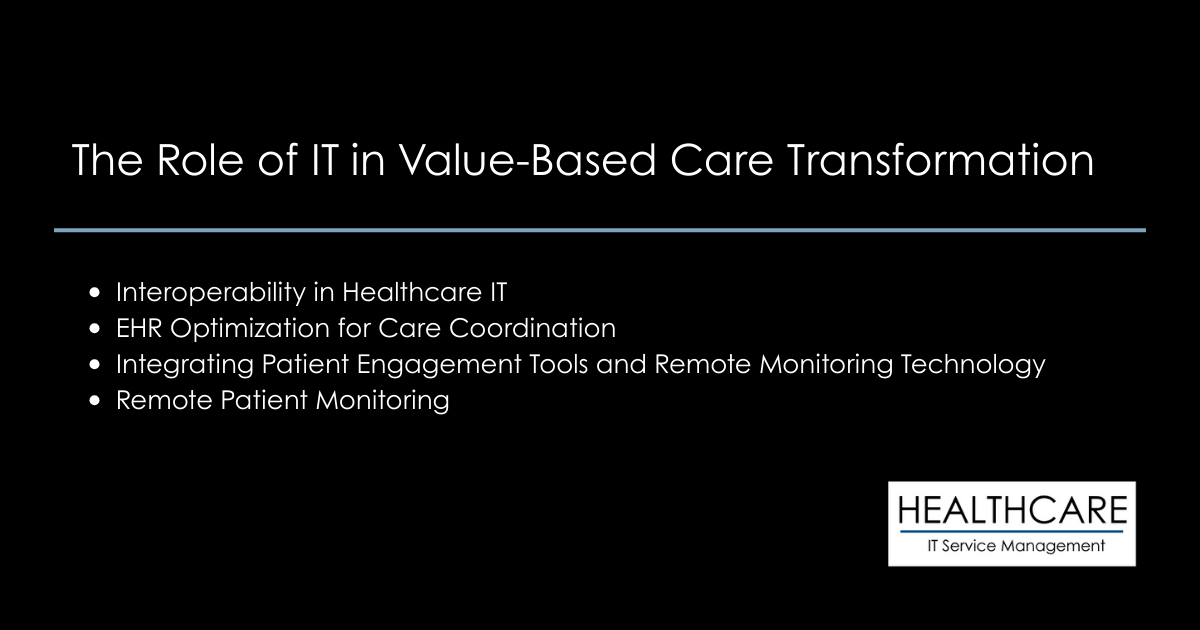
The Role of IT in Value-Based Care Transformation
Healthcare IT value-based care must be built on a strong IT infrastructure for multiple reasons. Certain tasks may be automated, saving staff time and energy. It also allows teams to collaborate and communicate easily and efficiently, with tools such as project management systems and cloud-based platforms that keep all staff on the same page.
In these instances, healthcare IT consulting is a major asset, as it helps improve how staff use IT systems while improving patient care.
Interoperability in Healthcare IT
An important part of infrastructure in value-based care is interoperability in healthcare IT, which allows data to be easily passed to all departments within the system. For this to be possible, the infrastructure must include a number of upgrades, such as updated legacy systems, utilizing cloud-based infrastructure, adopting data governance to maintain accuracy, and ensuring the safety of private data.
EHR Optimization for Care Coordination
EHR optimization for value-based care also factors into interoperability, as it enables easy data access across all systems in the facility. Patient care is also improved because all staff can view the patients’ updated, accurate information, minimizing errors made in treatment and streamlining workflows. Healthcare staff are also able to work together and communicate in a more efficient manner.
Integrating Patient Engagement Tools and Remote Monitoring Technology
Digital tools in the healthcare industry offer many benefits for healthcare professionals and their patients. In fact, research published in JMIR Medical Informatics has found that IT platforms that prioritize patients reflect an improvement rate of 88.8% in responses to patients’ treatment, with an 82.9% improvement in patient engagement (Sawesi, 2016).
Platforms that make a difference in these areas involve telemedicine, applications that promote healthy lifestyles, patient portals that allow patients to view their health records, and platforms that monitor patients remotely.
Telehealth is a crucial resource for both healthcare organizations and their patients, especially for those living in remote areas or those who do not feel well enough to leave their homes. This platform was heavily used during the COVID-19 pandemic since it allows doctors to treat their patients through video appointments without having to see them in person.
Patient portals, available through EHRs, have greatly impacted patient engagement. Portals allow patients to not only see their records but also make updates if needed. Individuals may also make appointments and send secure messages to their physicians. Research published in a 2020 article posted on ASTP Health IT Data Brief stated that of the 60% of people who have access to patient portals, about 40% consistently log in (Johnson, et. al., 2021).
Remote Patient Monitoring
Remote patient monitoring (RPM) systems also substantially increase patient engagement, as applications are often linked to medical devices used for monitoring patients. Blood sugar levels, blood pressure, and weight are just a few things that may be monitored by devices connected to the Internet of Things (IoT) to update healthcare data in real time.
Apps associated with RPM can involve things like following a suggested exercise routine, demonstration videos, or quizzes that help the patient take part in their treatment.
Leveraging Data Analytics to Drive Better Outcomes
Predictive analytics is one of the primary types of data analytics used in the healthcare industry. It uses statistical algorithms, machine learning strategies, and data to anticipate upcoming outcomes. Healthcare data analytics solutions allow healthcare providers to formulate a plan to meet the needs of their patients and anticipate outbreaks of disease or other health hazards.
Based on this kind of model, the likelihood that patients may develop certain illnesses can be determined by reviewing their lifestyles and medical history. Reviewing this data is a proactive approach to patient care, as it leads to early detection, allowing physicians to intervene quickly so that illnesses, diseases, or chronic issues can be treated before they worsen.
Enhancing Operations
Another key aspect of healthcare data analytics involves helping healthcare facilities enhance their operations by pinpointing processes that are inefficient and costly. For instance, a hospital may use this information to anticipate the number of patients they may have in order to adequately prepare with enough staff and necessary resources. Understanding the average flow of patients can also allow healthcare staff to minimize wait times, create a better schedule for operations, and optimize bed management.
Preventative Treatments
Making advancements in patient care also involves preventative treatments. Data analytics can help enhance this kind of care. Analyzing major datasets can detect risk factors for patients who have a higher chance of developing specific health issues. Pinpointing these risk factors enables providers to start preventative treatments, which prevent the early onset of chronic illnesses, minimize medical costs, and enhance the patient’s well-being.
The Importance of Centralized Data Systems
Healthcare facilities need clean, centralized data systems, as they are a critical part of making informed decisions, ensuring operations are running smoothly, and securing essential systems. These systems also help minimize costs by getting rid of duplicated or unnecessary data and streamlining processes with one centralized source of data, all while decreasing medical errors that result from incorrect or incomplete medical records.
Most importantly, clean data allows healthcare facilities to meet compliance regulations and standards. Patients, policy makers, and other providers will find that the facility is trustworthy.
Cybersecurity and Compliance: The Hidden Backbone of Value-Based Care
It is crucial for healthcare facilities to have secure, compliant healthcare systems. Failure to do so means potentially compromising patient data and outcome metrics. Additionally, it may lead to patient distrust, cause a loss of funds, and threaten the safety of patients’ personal data.
In the event that a cyberattack occurs, bad actors could steal medical records and sell them on the dark web. Under other circumstances, individuals could change patient data, causing dangerous health conditions or errors. Ransomware threats can result in an attacker keeping pertinent health records hostage, detaining vital treatments, and causing major disruptions to patient care, sometimes resulting in their death.
Because of the serious threat of a cyber attack, cybersecurity should be a top priority for all healthcare facilities.
HIPAA and HITECH
HIPAA and HITECH security rules exist to keep patient records safe. The HIPAA Security Rule, in particular, requires medical professionals to keep electronic medical records safe by utilizing proper administrative, technical, and physical safeguards.
These safeguards are outlined by HIPAA as administrative policies, actions, and procedures intended to safeguard electronic medical records and ensure healthcare professionals and facilities take adequate steps to protect health information (45 C.F.R. 164.304).
The Health Information Technology for Economic and Clinical Health (HITECH) Act is enforced as a means of handling privacy and security issues surrounding electronic health records that provide further support to HIPAA laws.
Risk Management Practices
In healthcare, risk management involves:
- Reviewing current procedures and practices to determine any risks or opportunities
- Pinpointing the chance of them taking place and the effect they could have
- Using controls to avoid significant loss and enhance profits
Each healthcare facility’s risk management procedures may be different, as risks are associated with the chance of certain threats resulting in disastrous outcomes to patients or the facility.
Empowering Clinical Teams Through IT Alignment

One aspect of patient outcome improvement through IT is made possible through the collaboration between IT and clinical leadership. This involves both IT teams and healthcare staff working together to identify the issues, then determining the technological solution that will best suit those needs. Implementing cross-functional collaboration ensures that all stakeholders are working towards the same goal.
Once a technological solution is apparent, it is crucial to train both healthcare staff and the IT department. Have additional support systems available to respond to any questions or concerns that will likely come up when it is first executed.
Offer continual training and learning as changes and advancements to the system take place. Consider utilizing intuitive user interfaces that do not require extensive training, These are typically more enjoyable to use, can save on costs for IT support, and may even make task completion faster. An even better solution is healthcare IT service management, which eliminates the need to hire and train a new IT department.
Measuring ROI in Value-Based Care IT Investments
Multiple components are involved in measuring ROI in healthcare technology, such as determining goals and establishing KPIs that correlate with these goals. Metrics that matter the most include reducing costs, readmission rates reflecting the quality of the facility, and patient satisfaction regarding the treatment they received. Determining ROI must be continually reviewed and adapted as needed to secure successful outcomes.
When communicating the value of IT to the C-suite, it is essential to demonstrate a thorough understanding of the organization’s goals and how IT aligns with its mission while also keeping to the budget. Explain the financial gains, such as how it will save funds and generate revenue.
Most importantly, focus on how these IT solutions will benefit patients and enhance their care. Include specifics: for example, explain the improvement of recovery times, reduction of readmission rates, or increased satisfaction of patients. Make sure to back up your claims with extensive evidence. This can involve case studies where examples of other healthcare facilities’ successes can provide credibility.
Building a Roadmap for Sustainable VBC Success

Enhancing patient care, improving operational efficiency, and ensuring that data is secure are some of the most useful IT strategies that support value-based care in healthcare facilities. Optimizing EHR systems and interoperability guarantees that facilities are integrating best practices for keeping patient data private while also creating an integrated network in which all information is easily accessible.
Equally important is increasing patient engagement by providing easy access to care with services such as telemedicine or wearable devices. Streamlining processes and workflows is also key to increasing productivity while minimizing staff burnout. Maintaining trust with patients by implementing strong cybersecurity systems and meeting HIPAA compliance is paramount.
To learn more about IT solutions for your healthcare organization, partner with Healthcare ITSM for implementation, assessment, or roadmap planning. Contact us to take a Value-Based Care IT Assessment.
Sources:
- ChenMed. (n.d.). How shifting to value-based care benefits physicians and patients. ChenMed. https://www.chenmed.com/blog/how-shifting-value-based-care-benefits-physicians-and-patients
- Friedberg, M. W., Chen, P. G., Van Busum, K. R., Aunon, F., Pham, C., Caloyeras, J. P., Mattke, S., Pitchforth, E., Quigley, D. D., Brook, R. H., Crosson, F. J., & Schneider, E. C. (2015). Factors affecting physician professional satisfaction and their implications for patient care, health systems, and health policy. RAND Corporation. https://www.ncbi.nlm.nih.gov/pmc/articles/PMC4742621/
- Long, P., Masi, P., & Adams, K. (Eds.). (2021). Building the workforce to support the medical city: A case study. In The Future of Nursing 2020-2030: Charting a Path to Achieve Health Equity. National Academies Press (US). https://www.ncbi.nlm.nih.gov/books/NBK609332/
- Sharp, J. (2024, June 6). Integrating patient engagement solutions for enhanced value-based care outcomes. Healthcare IT Today. https://www.healthcareittoday.com/2024/06/06/integrating-patient-engagement-solutions-for-enhanced-value-based-care-outcomes/
- Park University. (n.d.). Data analytics in healthcare: Transforming patient care delivery. https://www.park.edu/blog/data-analytics-in-healthcare-transforming-patient-care-delivery/
- GreenM. (n.d.). A comprehensive guide to EHR optimization strategies. Medium. https://medium.com/greenm/a-comprehensive-guide-to-ehr-optimization-strategies-98a27813f2d8
- U.S. Government Publishing Office. (2010). 45 CFR §164.106 – Compliance dates for implementation of new or modified standards and implementation specifications. https://www.govinfo.gov/content/pkg/CFR-2010-title45-vol1/pdf/CFR-2010-title45-vol1-sec164-106.pdf
- U.S. Department of Health & Human Services. (n.d.). HITECH Act enforcement interim final rule. https://www.hhs.gov/hipaa/for-professionals/special-topics/hitech-act-enforcement-interim-final-rule/index.html
- American Medical Association. (n.d.). HIPAA security rule: Risk analysis. https://www.ama-assn.org/practice-management/hipaa/hipaa-security-rule-risk-analysis
- AvaSure. (n.d.). Top 5 ways IT and clinical leaders can collaborate on virtual care programs. https://avasure.com/blog/top-5-ways-it-and-clinical-leaders-can-collaborate-on-virtual-care-programs/
- HIPAA Journal. (n.d.). Risk management in healthcare. https://www.hipaajournal.com/risk-management-in-healthcare/

With over 16 years in the industry, Jameson Lee has honed his skills in IT management, project execution, and strategic planning. His ability to align technology initiatives with business goals has consistently delivered remarkable results for organizations across various sectors.
Jameson’s educational background includes an Associate of Applied Science degree in Computer Networking Systems, providing him with a solid foundation in technical concepts and best practices. Complementing his technical acumen, he has also completed coursework in Business Administration, equipping him with a well-rounded understanding of the operational aspects of running successful businesses.
Driven by a commitment to staying ahead of industry trends, Jameson actively pursues professional certifications and continuous learning opportunities. His credentials include CompTIA A+, N+, and Security+, along with MCP and MCTS certifications. This dedication ensures that he remains at the forefront of technological advancements, enabling him to offer innovative solutions to complex challenges.
What sets Jameson apart is his personable approach to working with clients. He believes in fostering strong relationships and effective communication, collaborating closely with stakeholders to understand their unique needs, and provide tailored technology solutions. By building trust and understanding, Jameson ensures that every project is aligned with the client’s vision and objectives.
Throughout his career, Jameson has successfully led teams and implemented robust frameworks to optimize performance and achieve remarkable technological initiatives. Whether it’s streamlining operations, enhancing cybersecurity measures, or implementing cutting-edge software solutions, Jameson has consistently delivered tangible outcomes for his clients.
As a trusted IT partner, Jameson’s mission is to empower businesses with technology solutions that drive growth, efficiency, and competitive advantage. With his expertise, dedication, and personable approach, Jameson Lee is the catalyst for transforming your business through the power of technology.