
From staff shortages to resource scarcity, working in healthcare comes with constant challenges. This often makes it difficult for employees to feel empowered with the resources they need to care for their patients, a critical concern for healthcare businesses. Empowerment and informed decision-making can become even more challenging when you lack effective ITSM metrics.
It’s not uncommon for traditional IT service management measures to fall short in environments as complex as healthcare. However, ITSM shortcomings can significantly impact your productivity and overall success. IT performance is directly linked to the safety of your patients, the efficiency of your clinic, your ability to maintain regulatory compliance, and your ability to protect your staff from experiencing burnout.
To make matters more complicated, what looks good in reports may not always reflect actual progress. Using Healthcare ITSM to align metrics with healthcare outcomes can inspire staff and motivate continuous improvement in patient protection and clinic success.
Why Healthcare IT Metrics Are Different
For years, businesses have relied on Key Performance Indicators, or “KPIs,” to determine whether methods have been successful. While this may be an effective tool in many other fields, the world of healthcare is unique. Healthcare is patient-focused, which means your staff and patients’ needs can change at any time, and you may need to adjust your treatment methods accordingly.
Generic IT KPIs work well for monitoring consistent data, but healthcare is dynamic, and it deserves access to tools that match its changing needs and landscape.
There are several different things that the improper use of KPIs and/or insufficient IT systems can negatively impact, including:
Patient Care
IT downtime isn’t just inconvenient; these system failures can delay care, diagnostics, or medication orders, exposing your patients to unnecessary suffering and causing unwarranted stress. Clinical systems, such as EHRs, PACS, and lab systems, are mission-critical. You depend on their functionality to maintain your services, and your patients rely on them to receive the care they need.
Compliance Pressure
In this technologically advanced age, healthcare is no longer built upon paper records. Your patients’ information, allergies, medical histories, and records of care are typically stored electronically, leaving them vulnerable to cybersecurity risks if your generic IT resources cannot adequately protect them.
Laws regarding healthcare and information have also changed, including HIPAA, HITECH, the Joint Commission, and other regulatory bodies, raising the stakes and increasing the need for reliable and effective IT systems. Poor incident handling can result in fines, audits, or reputational damage, leaving your patients and your business in the lurch.
Clinical Uptime Requirements
Unlike corporate IT, healthcare services operate 24/7. There are no “days off”, which means you have no time for your technology to falter or shut off. Even “off-hours” incidents can impact patient outcomes, leaving you with vital needs and no system to help you meet said needs.
What may seem like a minor glitch resulting in a delayed EHR system login during a shift change could leave a patient without necessary care, opening you up to lawsuits, reputational damage, and more from an inability to anticipate and meet your patients’ needs.
Metrics That Actually Move the Needle
Determining what metrics could benefit your patients, protect your team from burnout, and grow your clinic’s resources and reach is essential in helping your healthcare practice thrive.
The following are important metrics to consider:
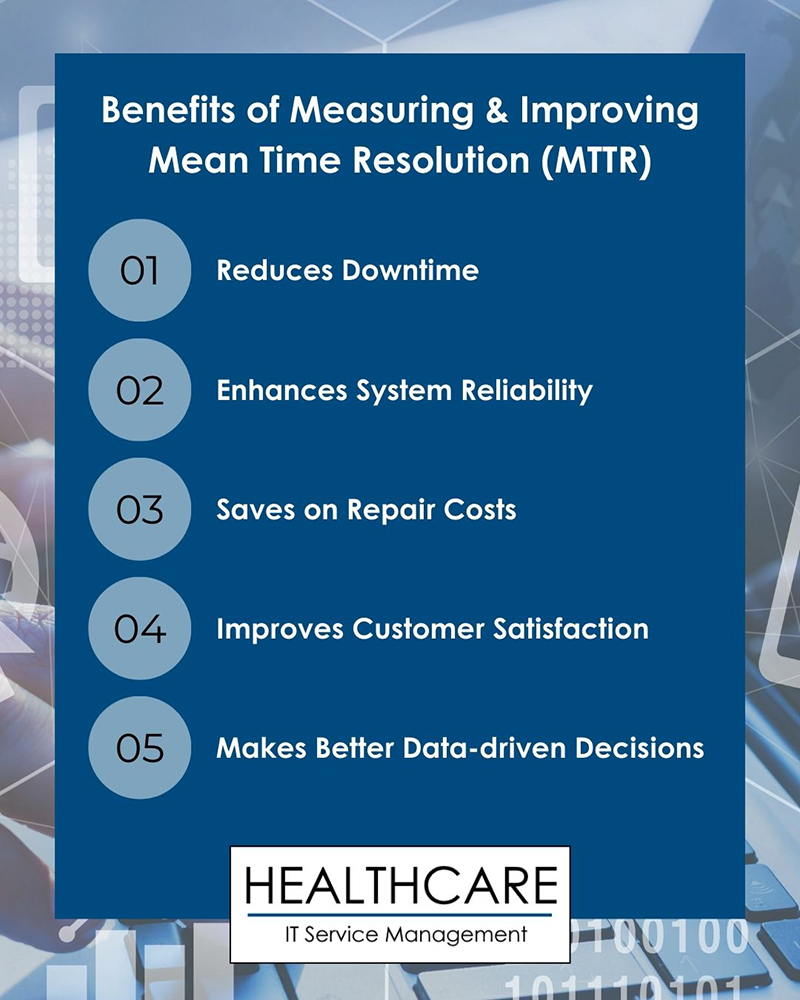
Mean Time to Resolution (MTTR) for Clinical Systems
While every IT ticket deserves attention, some use cases demand precedence. Healthcare is one such field. The stakes can literally be life and death, and waiting to hear back from a 9-5 generic IT service can leave you and your patients in the lurch.
Prioritizing IT tickets properly is of the utmost importance in healthcare. While a faulty printer can be inconvenient, resolving an EHR issue in 15 minutes matters so much more than repairing the printer in under 5 minutes. Clinical-impacting tickets should always be prioritized, but this may not hold true when implementing generic IT resources.
Tracking the Mean Time to Resolution, or “MTTR,” can be a helpful and effective way to determine the typical time required to fix technological issues, thereby creating an IT ticket hierarchy and preventing critical repairs from being pushed to the bottom of the pile. The timeliness of attention that a ticket receives may be the difference between life and death.
First Contact Resolution (FCR) for Clinicians
First impressions matter, especially when you are trying to develop the most fitting healthcare plan for your patients. Physicians and clinicians need to answer as many of the prospective patient’s questions as possible during the first visit, call, or chat session. This can be difficult to do when you lack the IT support you need.
Technological interruptions, while not an accurate indicator of your care quality, can leave patients feeling vulnerable and apprehensive. It can also disrupt the flow of your interaction, leaving your patient with unanswered questions and requiring you to schedule a follow-up appointment that was previously unnecessary.
At Healthcare ITSM, we believe in achieving higher First Contact Resolution (FCR) from the start, protecting you and your patients from workflow disruptions. Your time is much better spent helping your patients, and we can help you avoid time wasters and back-and-forth by establishing a strong connection from the beginning.
Ticket Volume by Department or System
One of the most significant benefits of having effective, efficient IT systems in place is that you and your organization can be protected from being overwhelmed by the volume of uncategorized IT tickets. When you use critical ITSM metrics, you can identify where your IT problems are actually occurring, such as in ED, radiology, or your inpatient units.
When your IT issues are categorized, you can address the main issues and identify systemic issues versus isolated user problems. Your tickets can avoid getting lost in the process, and you can also see which areas seem to be struggling through itemized department IT weaknesses.
Incident Recurrence Rate
As any seasoned healthcare professional will tell you, symptom management does not address the root issue. Instead of wasting your time trying to address the side effects of a bigger problem, you can use useful IT tools, like the Incident Recurrence Rate, to show whether the primary issue has been addressed.
If a high recurrence of the issue is reported, you will know to look into the underlying system, configuration, or even training issues. This enables you to cut back on time spent treating symptoms and instead dedicate your resources to solving the greater problem.
Change Failure Rate in EHR Environments
Since healthcare never truly takes a break, it can be both stressful and problematic to implement network updates, navigate periods of disconnection, and work with integrations. Determining the Change Failure Rate in EHR environments can help you identify when these issues may arise, allowing you to avoid downtime, maintain change governance, and ensure patient safety.
Untimely updates and glitches can prevent your patients from getting the care they need, but being able to observe and determine your clinic’s change failure rate can protect both you and them from inconvenient gaps in the care process.
Metrics That Look Good but Don’t Help
Technology is an ever-evolving field, which means that, while you may have been taught that specific systems are beneficial or essential, they may now prove to be outdated and inconvenient.
Here are some examples of IT systems that may look good on paper, but, in reality, offer you more problems than solutions:
Raw Ticket Counts
While it may seem like faulty logic, having more IT tickets does not always mean that your system is performing worse. When your metrics-monitoring system stays on top of potential IT issues, the number of problems may increase. This will allow you to be aware of all potential issues, rather than having the same problems without realizing it.
A drop in tickets may signal underreporting rather than improvement. Having the right system in place can help you determine whether or not this is the case.
Vanity SLA Percentages
Even though the concept of “99.9% SLA met” may look impressive, it does not necessarily mean that clinicians were effectively supported. SLAs often ignore the severity of the issue and the clinical context in which these clinicians are operating.
Over-Automated “Green Dashboards”
Dashboards that always show green can mask real issues. While this can feel like a positive development, automation without interpretation can create blind spots, leaving you underprepared to handle issues just below the surface.
How to Align ITSM Metrics with Healthcare Outcomes
Correctly understanding the inner workings of your IT system can help drive strategy and growth through data-driven IT leadership, enabling you to meet the needs of everyone connected to your clients, including your patients, team, and legal representatives.
Patient Safety
Faster incident resolution can reduce the risk of delayed or even incorrect care, offering your patients protection as well as protection for you and your team from potential malpractice lawsuits. Better change control can also lower IT downtime during critical hours, equipping you with the resources you need to meet your patients’ needs.
Staff Burnout Reduction
IT inconveniences may not seem like a significant factor in staff burnout. Still, they can truly be the difference between maintaining your whole team and suffering from a revolving door of employees.
Fewer recurring issues can lead to fewer interruptions for clinicians, allowing them to focus on and accomplish their work, as well as equipping and empowering them to help their patients. Good IT support improves morale and trust in both the clinic and IT teams.
Compliance Readiness
Strong metrics support audit readiness and documentation, and help promote awareness of potential cybersecurity risks that could prevent compliance with healthcare ordinances. Through incident tracking, your clinic can support HIPAA and meet security requirements.
Turning IT Metrics into Action (Not Reports Nobody Reads)

Metrics should drive decisions, not just fill dashboards.
Here are three ways that utilizing your observed metrics can help improve your clinic, your team’s capabilities, and your patients’ overall experiences:
- Use your metrics in weekly or monthly operational reviews. This keeps your team up to date and allows for a general awareness of your system’s efficacy.
- Tie your metrics to improvement initiatives, giving your team a visual of their goals and how you want the clinic to improve as a whole.
- Share your insights with clinical leadership, and not just with IT. While IT can help you improve the success rate of your systems, your clinical leadership can help determine how best to channel that success.
Learn More Today
Every day, you make sacrifices and decisions that help improve and sustain your patients’ lives. When you are left unprepared, you cannot meet your team’s needs, much less those of your clinic’s patients. Let Healthcare ITSM help improve your ability to do so.
Contact Healthcare ITSM today to schedule a free consultation with our team and find out how we can help you keep your clinic running, your staff happy, and your patients protected.

With over 16 years in the industry, Jameson Lee has honed his skills in IT management, project execution, and strategic planning. His ability to align technology initiatives with business goals has consistently delivered remarkable results for organizations across various sectors.
Jameson’s educational background includes an Associate of Applied Science degree in Computer Networking Systems, providing him with a solid foundation in technical concepts and best practices. Complementing his technical acumen, he has also completed coursework in Business Administration, equipping him with a well-rounded understanding of the operational aspects of running successful businesses.
Driven by a commitment to staying ahead of industry trends, Jameson actively pursues professional certifications and continuous learning opportunities. His credentials include CompTIA A+, N+, and Security+, along with MCP and MCTS certifications. This dedication ensures that he remains at the forefront of technological advancements, enabling him to offer innovative solutions to complex challenges.
What sets Jameson apart is his personable approach to working with clients. He believes in fostering strong relationships and effective communication, collaborating closely with stakeholders to understand their unique needs, and provide tailored technology solutions. By building trust and understanding, Jameson ensures that every project is aligned with the client’s vision and objectives.
Throughout his career, Jameson has successfully led teams and implemented robust frameworks to optimize performance and achieve remarkable technological initiatives. Whether it’s streamlining operations, enhancing cybersecurity measures, or implementing cutting-edge software solutions, Jameson has consistently delivered tangible outcomes for his clients.
As a trusted IT partner, Jameson’s mission is to empower businesses with technology solutions that drive growth, efficiency, and competitive advantage. With his expertise, dedication, and personable approach, Jameson Lee is the catalyst for transforming your business through the power of technology.