IT support is essential for modern healthcare organizations, as continuity of care, patient privacy, efficiency, and bookkeeping depend on streamlined, secure information technology systems. Many healthcare organizations know they need better technology support but aren’t sure whether to hire an IT consultant or a managed IT provider. Although these services overlap, they solve different problems.
If your organization needs better IT, this guide is for you. Learn the differences between IT consulting and managed IT services in the healthcare industry so you can choose the approach that best fits your needs.
What Is Healthcare IT Consulting?
Every healthcare organization needs a defined plan for its IT choices. Oversights, gaps, and inefficiencies in IT systems can lead to security breaches, eroded trust, financial losses, and more. Healthcare IT consulting involves seeking expert advice from an IT professional regarding an organization’s IT strategies and systems.
Some examples of areas in which a healthcare organization might benefit from IT consulting include:
- Technology Assessments – An experienced healthcare IT consultant can evaluate existing systems to determine whether an organization is using modern technology to its fullest potential.
- Digital Transformation – Given the ever-evolving healthcare IT landscape, organizations often need a global reorientation. IT consultants can help organizations plan for transition periods and execute the associated plans.
- EHR Planning – Electronic health records are integral to a modern healthcare organization, but switching to a new system or upgrading an existing one can be a massive undertaking.
- Cybersecurity Planning – Patients trust healthcare organizations with their personal data. Securing that data and putting protocols in place to handle any potential breaches is essential to any IT plan.
- Cloud Migration – Moving an organization’s data from a local environment to the cloud requires proper preparation and logistical planning.
- Vendor Selection – An experienced IT consultant can help an organization choose vendors that will work well with the vendors and systems already in place.
- Compliance Planning – Healthcare organizations must maintain compliance with HIPAA and other information security laws and policies.
- IT Budgeting – IT consultants can help organizations determine how best to spend their IT budgets by evaluating existing systems and running cost-benefit analyses on potential changes.
- Roadmaps – Roadmaps are overarching plans that outline an organization’s IT situation, the direction it needs to go, and how to get there. Consultants can help with these big-picture plans.
Essentially, a healthcare IT consultant can fully evaluate an organization’s systems, identify areas for improvement, help create short-, medium-, and long-term plans, and provide expert advice on how to execute them.
What Are Managed IT Services?
Whereas IT consultants provide evaluations and advice, managed IT services take things a step further by providing ongoing, real-time support to healthcare organizations. Some examples of healthcare managed IT services include:
- Help Desk – A virtual help desk is a common element of a managed IT services package. A help desk is useful because individuals in an organization can access IT support in real time and solve problems quickly.
- Device Management – In modern healthcare organizations, devices need to work. Managed IT services can help by keeping an organization’s devices updated, configured, and operational.
- Monitoring and Patching –A managed IT services provider can monitor systems for failures, bugs, or other problems. Patching is the process of installing updates that address these problems as they arise.
- Security – In the healthcare sector, security is one of the most important aspects of IT. Managed IT services can provide organizations with constant security monitoring and a quick response to problems.
- Backups and Disaster Recovery – Lost data can cause far-reaching, system-wide problems for healthcare organizations. Managed IT services can help ensure proper backups are in place. If a disaster-level event occurs, they can implement a plan and provide support for recovery.
- Microsoft 365 Management – For organizations that rely on Microsoft 365 for day-to-day operations, managed IT services can provide maintenance, maintain security, and support use of the Microsoft 365 environment across the organization.
- Network Management – Managed IT services can also include network administration, including onboarding new users, deactivating users no longer working for the organization, and maintaining connectivity, both onsite and remote.
A managed IT services provider essentially becomes an extension of the healthcare organization’s IT department.
Healthcare IT Consulting vs. Managed IT Services
Healthcare managed IT services and consulting both have benefits and drawbacks, and the best option depends heavily on the organization’s needs and budget. The following table illustrates some of the benefits of each approach:
| Healthcare IT Consulting | Managed IT Services |
|---|---|
| Strategic planning | Daily support |
| Project-based | Ongoing partnership |
| Technology roadmap | System maintenance |
| Vendor recommendations | Help desk |
| Compliance planning | Security monitoring |
| Budget planning | Patch management |
| Transformation initiatives | User support |
When Healthcare IT Consulting Makes Sense
There are some situations in which healthcare IT consulting makes the most sense for an organization. This is often the best option when higher-level support and strategic planning are the primary needs.
Some examples of when a consultancy approach might be the best course of action include the following:
- Opening New Locations – Opening a new business location comes with a series of logistical puzzles, and setting up IT structures is no small task. A consultant can help an organization get a new location online as efficiently as possible.
- Replacing an EHR – Changing from one electronic healthcare record system to another is time-consuming and requires careful planning. Data must be kept secure, potential problems must be anticipated and mitigated, and personnel must be trained on the new system.
- Mergers or Acquisitions – When a healthcare organization acquires another business, it must assimilate the new into the old, update systems, and move forward as seamlessly as possible.
- Cloud Migration – Moving an organization from a local environment to a cloud environment can be a complicated feat. An IT consultant can help an organization predict and mitigate potential issues, then execute a smooth transition.
- Security Assessments – If an organization’s primary goal is to assess its current security situation and make any necessary improvements, IT consulting can provide these services best.
- HIPAA Planning – All healthcare organizations must comply with HIPAA regulations, and new issues consistently arise as technology evolves.
- IT Budgeting – When an organization needs to decide how to spend its IT budget, a consulting service can help to develop a healthcare IT strategy to use the budget most effectively.
- Infrastructure Modernization – Technology develops quickly, and organizations sometimes find themselves years behind the times in their IT resources. Healthcare IT consulting services can help organizations stay current and implement the most effective technologies.
When Managed IT Services Are the Better Choice
In some cases, managed IT services are the more appropriate choice for a healthcare organization. When an organization’s needs are more day-to-day than high-level strategy, managed IT services are often a better fit than consulting services.
Small healthcare practices and those with a limited or nonexistent IT department may benefit significantly from managed IT services. When an organization’s primary needs include a help desk, around-the-clock monitoring, or security and compliance support, this approach is better suited to meet those goals.
Additional circumstances that can benefit from managed IT for healthcare include the following:
- Limited IT staff
- Frequent support requests
- Backup management
When Organizations Need Both
Some organizations can benefit from both healthcare IT consulting and managed IT services. In these cases, the two approaches can act together as part of a comprehensive IT development and management plan.
When an organization seeks IT consulting services, a consultant can:
- Collaborate with management to build an IT strategy.
- Construct a roadmap to reach IT goals.
- Create an infrastructure plan based on the organization’s needs and existing systems.
On the managed IT services side, an IT services provider can:
- Execute the plan the consultant created.
- Provide technical and logistical support throughout the transition and beyond.
- Monitor the IT system as a whole and identify any issues.
- Make changes to improve the existing system and streamline processes to support organizational goals.
In situations like these, IT consulting services and managed IT services can work together in a cohesive system that optimizes an organization’s approach to healthcare IT.
Questions to Ask Before Choosing an IT Partner
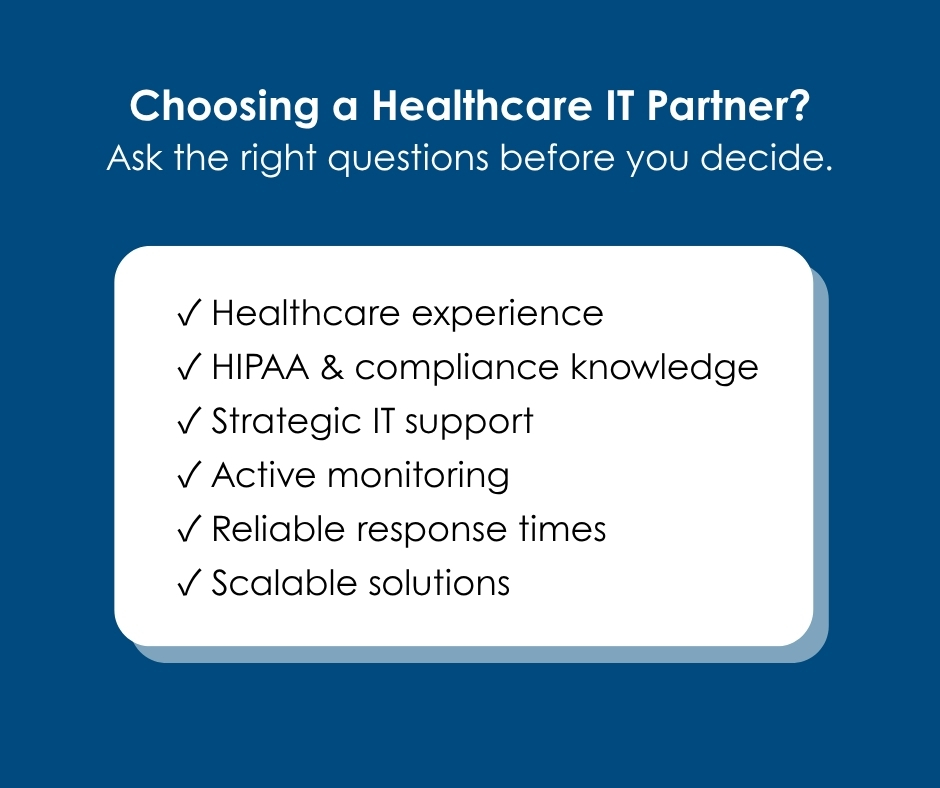
If you are looking for IT support for your healthcare organization, take time to consider a prospective partner’s qualifications, experience, and expertise before you sign a contract.
Some useful questions to ask include:
- Does the IT service provider specialize in healthcare?
- Do they understand HIPAA?
- Can they support compliance initiatives?
- Can they help with strategic planning?
- Do they provide active monitoring?
- What is their response time for general inquiries and urgent matters like security breaches?
- Do they have references from healthcare organizations?
- If the organization grows, can the IT provider scale operations to support that growth?
How Healthcare ITSM Helps Healthcare Organizations
Healthcare ITSM is a full-service IT support provider for healthcare organizations. Whether an organization needs high-level strategic planning and oversight, day-to-day support and monitoring, or a mix of both, Healthcare ITSM brings expertise, experience, and cost-effective solutions. Through infrastructure evaluation and the care and familiarity that come with a long-term professional relationship, the following are some of the organizational needs Healthcare ITSM can help meet:
- Strategic Consulting – When an organization needs an analysis of its existing IT infrastructure and a blueprint for moving forward, Healthcare ITSM can provide comprehensive strategic consulting services to create a plan aligned with organizational needs.
- Managed IT Services – For organizations that need day-to-day support, Healthcare ITSM provides complete managed IT services, including a help desk, monitoring, Microsoft 365 management, and more.
- Security and Compliance – Healthcare ITSM understands healthcare organizations’ security and compliance needs.
- Cloud Services – Whether an organization is migrating from a local environment to the cloud or needs help managing its cloud environment, Healthcare ITSM can manage transitions and provide support.
IT FAQs
Contact Healthcare ITSM
Need help deciding whether healthcare IT consulting or managed IT services are the right fit?
Contact Healthcare ITSM to discuss your organization’s goals and request an IT assessment.

With over 16 years in the industry, Jameson Lee has honed his skills in IT management, project execution, and strategic planning. His ability to align technology initiatives with business goals has consistently delivered remarkable results for organizations across various sectors.
Jameson’s educational background includes an Associate of Applied Science degree in Computer Networking Systems, providing him with a solid foundation in technical concepts and best practices. Complementing his technical acumen, he has also completed coursework in Business Administration, equipping him with a well-rounded understanding of the operational aspects of running successful businesses.
Driven by a commitment to staying ahead of industry trends, Jameson actively pursues professional certifications and continuous learning opportunities. His credentials include CompTIA A+, N+, and Security+, along with MCP and MCTS certifications. This dedication ensures that he remains at the forefront of technological advancements, enabling him to offer innovative solutions to complex challenges.
What sets Jameson apart is his personable approach to working with clients. He believes in fostering strong relationships and effective communication, collaborating closely with stakeholders to understand their unique needs, and provide tailored technology solutions. By building trust and understanding, Jameson ensures that every project is aligned with the client’s vision and objectives.
Throughout his career, Jameson has successfully led teams and implemented robust frameworks to optimize performance and achieve remarkable technological initiatives. Whether it’s streamlining operations, enhancing cybersecurity measures, or implementing cutting-edge software solutions, Jameson has consistently delivered tangible outcomes for his clients.
As a trusted IT partner, Jameson’s mission is to empower businesses with technology solutions that drive growth, efficiency, and competitive advantage. With his expertise, dedication, and personable approach, Jameson Lee is the catalyst for transforming your business through the power of technology.