
In recent years, AI technology tools have been rapidly deployed in the healthcare industry. While many healthcare business owners were hopeful that AI would fix the fragmented issues plaguing the medical field, it is quickly becoming apparent that this is not the case.
Healthcare IT Service Management (ITSM) is at the frontlines of helping healthcare institutions better understand the role of AI in modern healthcare. Learn how you can implement the newest technologies while also making useful, lasting changes that go beyond relying solely on artificial intelligence.
AI Reveals What Is Already Broken
When healthcare companies implement AI prematurely, it can quickly become a crutch. The silver lining is that, although AI may not be the best way to fix your tech issues, it is, at the very least, a way to expose what is already broken in your system.
Here’s what AI might help you reveal:
Disconnected Systems
If everyone on your team regularly collected various kinds of essential information about the same patient but then refused to share it with other staff members, your patient would be subjected to annoying, expensive, redundant testing at best. At worst, their health and even their life could be at risk since providers are unable to proceed with care informed by complete information. If your systems are disconnected, your IT could be suffering the same side effects.
When your systems are not functionally and productively connected, you can easily end up wasting time and money trying to resolve data silos. Despite popular belief, AI does not eliminate these issues. In fact, it typically exposes them without offering a clear-cut solution.
Outdated Infrastructure
With technology advancing so quickly, it is easy to overlook outdated systems as you turn your attention to new ones. This can leave your security vulnerable, increasing the risk of ransomware and hindering both your operational efficiency and your ability to provide top-notch patient care.
AI can reveal outdated infrastructure that causes interoperability problems, increases maintenance costs, and typically fails to meet the latest HIPAA compliance requirements. Worse, outdated tech can cause recurring downtime and outages, hindering your productivity and your ability to meet patient needs.
Persistent Data Silos and Legacy Systems
For AI to work properly, you need to avoid siloing data. Unfortunately, when it comes to achieving clean, aggregated data, outdated legacy systems may fail to communicate properly, rendering AI deployment impossible.
This can further result in fragmented patient records, medication errors, increased care costs, and slower, less efficient care delivery. This wastes your staff’s and your patients’ time, decreasing productivity and patient satisfaction.
Failing to Address Workflow Integration
When AI systems and tools operate outside a standard clinical workflow, they can slow providers down and increase the burden on administrative workers. This can lead to lower adoption rates and cause disorder in your work environment.
The Accumulation Trap
It is common for healthcare systems to buy multiple siloed AI tools rather than creating and utilizing a strong, cohesive infrastructure. This can cause future delays, increasing the difficulty of obtaining and distributing essential data.
Accumulation can also create hidden debt, as it requires manual, fragmented workflows instead of the smooth operations each individual AI system promised.
Here are some other examples of the impact that the accumulation trap can have on IT healthcare outcomes:
- High Costs and Reduced Care Quality – When your team lacks the necessary data-sharing, it can lead to redundant testing, increasing costs for you and the patient. It can also lead to worse patient outcomes when inadequate data causes medical personnel to miss key details of the patient’s clinical history. This is especially problematic in emergencies.
- Operational Inefficiency and Burnout – Operational inefficiency often leads to clinicians wasting critical time as they are forced to hunt for essential information across fragmented, siloed, and non-communicating systems. This can lead to burnout, as more and more of a workday is spent fighting against a faulty system.
- Safety Risks –.Information silos can leave providers without essential information, such as a complete list of medications and/or allergies, thereby increasing the risk of adverse effects. Your patient’s safety matters most, but can be hard to ensure when your data is scattered across multiple systems.
- Vendor Lock-In – Sometimes, vendors prefer to use closed, proprietary systems, which makes data migration and sharing both expensive and technically difficult. This can also slow down interoperability.
What Is Interoperability and Why Is It Key to Success?
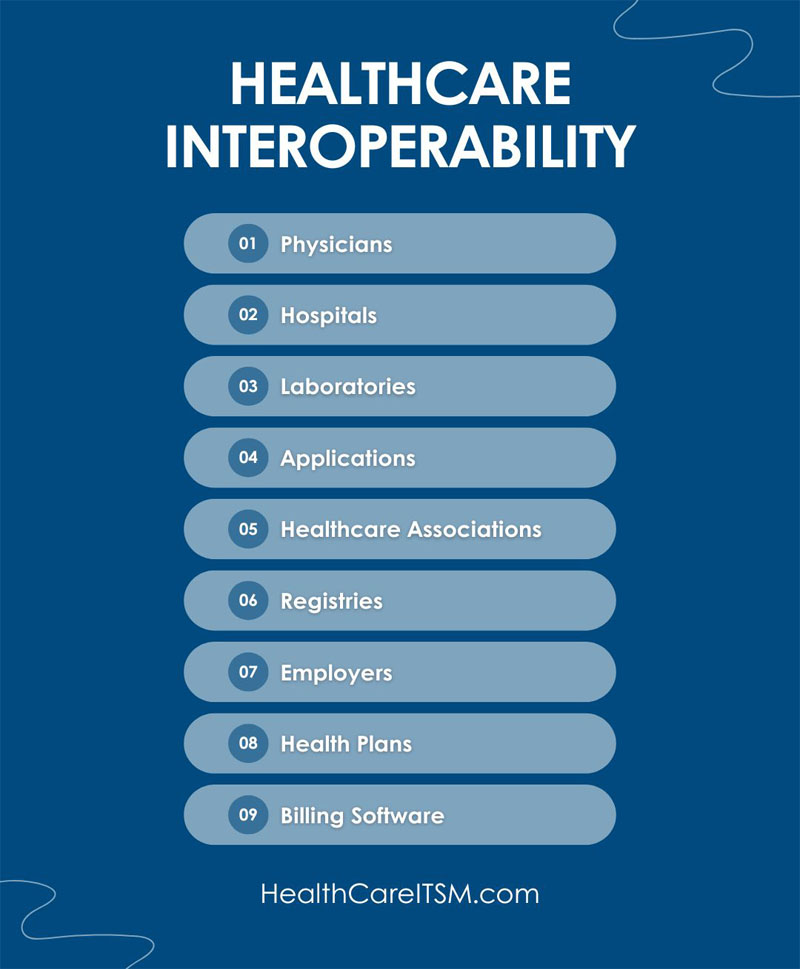
Interoperability is the key to successful technological communication in the world of healthcare. Simply put, it is the ability of different information technology systems, devices, and/or software applications to communicate with one another, exchanging data seamlessly.
Interoperability helps prevent individuals from having to make a special effort to obtain the data they need across different technological systems.
Here are some of the effects that interoperability can have on healthcare:
- Cost Reduction – When you are able to streamline administrative tasks, such as prior authorization, and avoid implementing duplicate tests, interoperability can free you up to reduce the cost of healthcare systems and treatments as a whole.
- Operational Efficiency – You can save significant amounts of time by using interoperability to reduce manual data entry, therefore enabling your employees and parents alike to have better access to their data. This can take the pressure off your staff and give them more time to carry out their necessary tasks, which would have otherwise been wasted on unsuccessful troubleshooting.
- Improved Patient Outcomes – Gaining access to accurate, comprehensive data from external providers in real time can facilitate safer, quicker diagnosis and treatment. This elevates your patient’s experience and makes them feel prioritized and looked after.
- Modernization and Compliance – When you adopt the standards held by FHIR and APIs, and meet the regulations set by the 21st Century Cures Act, you are departing from proprietary silos and choosing security and transparency instead. Interoperability is a great tool that can empower your team to make this happen.
Misalignment Is Common
Unfortunately, misalignment is extremely common. When IT, clinical operations, and leadership aren’t on the same page, no amount of automation can repair a broken system or faulty communication.
While AI tools often expose existing misalignments in a system, they’re typically unable to fix them. This is the core reason that simply installing and implementing AI will not solve your healthcare IT issues.
Before you consider utilizing artificial intelligence, it is wise to prioritize human intelligence. A consultation with an AI and IT expert gives you and your teams an opportunity to discuss what is causing miscommunication and increase the likelihood of successful, productive work in the future.
Prioritizing Purposeful Progress Instead of Momentary Convenience
Of course, it is human nature to always look for ways to make life more convenient. For example, carriages were introduced as an alternative to walking, making travel easier. Soon, automobiles were created to replace carriages. Now, self-driving cars may even eliminate the need to operate a motor vehicle at all.
While innovation and convenience would ideally go hand in hand in precisely this fashion, this is not always the case. Unfortunately, prioritizing momentary convenience and the speed of implementation over intentionality and purposeful progress can lead to far greater delays than the ones you were trying to avoid.
Just because things are going faster does not mean they’re going smoother. There may still be hidden flaws in your systems that could surface at inconvenient times.
Healthcare Organizations Need to Put Strategy Before Software
While AI can play a role in healthcare IT strategies, software solutions should never come before core strategies.
You are likely feeling the pressure to rush into acquiring and utilizing the latest AI tools, but this is rarely a good idea. Instead, request an IT audit to ensure the technology you have right now provides strong, foundational support, promoting security, interoperability, and overall scalability. Despite how powerful and convenient it may seem, AI will prove useless if it is built on a weak technological foundation.
Then, determine whether there are any other areas your system could improve in prior to installing new AI tools. That way, when you eventually decide to implement new technology, you know exactly how it will help your staff and patients communicate and work together harmoniously.
By taking a proactive, deliberate approach to aligning systems, people, and processes, healthcare organizations can more readily adopt AI. Strategies remain patient-centered, and outcomes are equipped for long-term performance and resilience.
The Impact of AI Combined With Human Intentionality
One of the primary reasons AI has truly taken off is that it helps humans and businesses alike meet their everyday needs. When work is more convenient, your employees are free to do what they’re passionate about – patient care (provided it is integrated into an already successful system).
By itself, however, AI fixes nothing. If your systems are broken, AI should be viewed as an eventual resource instead of a fix-all. Before you implement AI, get a consultation from a healthcare IT expert. Nothing is more successful and productive than human strategies combined with technological resources.
How We Can Help
At Healthcare ITSM, we believe in partnering our understanding of the medical field and its needs with our technological know-how. This enables us to align your business goals with our IT strategies, so AI can add value to your overall experience rather than create chaos.
Here’s how our understanding of AI can truly help you try to meet certain workplace needs and resolve issues:
Administrative Automation
When you successfully lay the groundwork for the use and implementation of AI tools, artificial intelligence can handle administrative tasks such as transcribing patient notes, managing billing, scheduling appointments, and completing paperwork. This can free your staff up to focus on more pressing needs, allowing them to devote more time to creating a personable and compassionate space for patients. It can also help prevent burnout, which feels almost inevitable in the healthcare industry.
Imagine the number of employees you could maintain by avoiding burnout alone.
Diagnostic Imaging and Analysis
Recent technological advances have enabled artificial intelligence to interpret medical imaging and scans, helping departments like radiology and cardiology with cases. With an accuracy level befitting a specialist, AI can identify a wide range of conditions, including tumors and heart disease.
This can free your doctors and other staff members to take on more cases than ever before, getting more patients the help they so desperately need. It can also give your doctors the opportunity to focus on how to handle a medical issue rather than spending time trying to determine what the issue may be in the first place.
Predictive Analytics
Similar to diagnosing potential health concerns through imaging and analysis, AI can also be used to predict health risks and identify individuals who may be at increased risk of readmission. This allows your team to focus on implementing preventive interventions, giving them the chance to try to avoid issues in advance rather than react to them as they occur.
Virtual Health Assistants
When you free your staff to take on more patients, it may increase your need for a reliable communication system. Virtual health assistants are AI-powered chatbots that can provide feedback and support at any time, day or night, on holidays and weekends. They can also answer common patient questions, assist with medication management, and even offer triage.
Start Developing Successful Strategies Today
AI may seem like a quick and efficient way to fix the bugs in your overall healthcare IT strategy, but this is rarely the case. Instead, it can throw you and your team even further off course from your intended goal of thorough, strategic care.
Don’t let AI amplify your inefficiencies – let’s fix the foundation first. With a strong IT framework, AI systems can bring order and productivity to your workplace, rather than the chaos and delays they may initially introduce.
While AI can expose misalignment, our Healthcare ITSM team can help you solve it.
Learn more about our services and packages today, and contact us at any time for a free consultation.
We understand how to turn AI from a measure of failure into a tool for success, and we are prepared to utilize our in-depth knowledge to help you, your staff, and your patients achieve the outcomes and functionality you deserve.

With over 16 years in the industry, Jameson Lee has honed his skills in IT management, project execution, and strategic planning. His ability to align technology initiatives with business goals has consistently delivered remarkable results for organizations across various sectors.
Jameson’s educational background includes an Associate of Applied Science degree in Computer Networking Systems, providing him with a solid foundation in technical concepts and best practices. Complementing his technical acumen, he has also completed coursework in Business Administration, equipping him with a well-rounded understanding of the operational aspects of running successful businesses.
Driven by a commitment to staying ahead of industry trends, Jameson actively pursues professional certifications and continuous learning opportunities. His credentials include CompTIA A+, N+, and Security+, along with MCP and MCTS certifications. This dedication ensures that he remains at the forefront of technological advancements, enabling him to offer innovative solutions to complex challenges.
What sets Jameson apart is his personable approach to working with clients. He believes in fostering strong relationships and effective communication, collaborating closely with stakeholders to understand their unique needs, and provide tailored technology solutions. By building trust and understanding, Jameson ensures that every project is aligned with the client’s vision and objectives.
Throughout his career, Jameson has successfully led teams and implemented robust frameworks to optimize performance and achieve remarkable technological initiatives. Whether it’s streamlining operations, enhancing cybersecurity measures, or implementing cutting-edge software solutions, Jameson has consistently delivered tangible outcomes for his clients.
As a trusted IT partner, Jameson’s mission is to empower businesses with technology solutions that drive growth, efficiency, and competitive advantage. With his expertise, dedication, and personable approach, Jameson Lee is the catalyst for transforming your business through the power of technology.